Lifewide Education
  • Home
    • About
    • Community
    • 2030 Vision
    • 2021 activities
    • White Paper
  • Lifewide Learning
    • Sustainable & Regenerative Futures >
      • Healthy Futures
      • Sustainable Futures Inquiry
      • Pathways >
        • Pathways Stories
        • Motivations
        • Inspring people
      • Lifewide Magazine 25
    • Our Learning LIves
  • Magazine
  • Inquiries
    • Earth Charter Inquiry >
      • Values & Beliefs Statements
    • LIVING & LEARNING WITH AI >
      • Lest we forget
      • First Meeting
      • Living with AI
      • Our relationships with AI
      • AI across life domains
      • Early morning tango with AI
      • AI & Transition Spaces
      • Concerns about AI
  • Books
    • Learning for a Complex World
    • Lifewide Learning, Education & Personal Development
    • Lifewide Learning & Education in Universities & Colleges
    • Professional learning
  • Blog
  • Resources
  • Lifewide Development Award
  • IHB3 seminar
  • INN
  • SDU
  • Qinghai
  • OU employability
  • EXPLORING LEARNING ECOLOGIES
  • Learning Lives Conference
  • John Cowan Podcasts
  • Participant reports

ecology of professional development 

10/9/2015

8 Comments

 
Picture
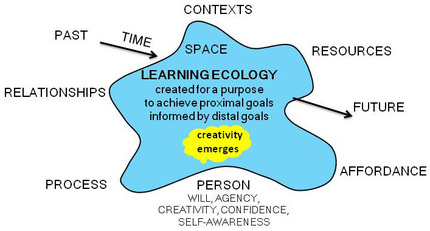
Our interest in learning ecologies has developed from our commitment to supporting and exploring the idea and practice of lifewide learning. Over the last three years we have published several issues of Lifewide Magazine, produced two book chapters, several posts and made numerous contributions to university conferences and other professional development activities. These bits and bobs have now been brought together in a book and we would appreciate greatly any feedback and suggestions for  further development.

Exploring Learning Ecologies draft chapters

In the next issue of Lifewide Magazine we want to explore the idea from the perspective of the ecologies we create to learn and develop in the work environment or in any other context that is relevant to professional development.

We invite you to share a story about a developmental process you have been involved in to develop yourself for an existing role or project in your work environment or to develop yourself for a new role or just to develop your knowledge or expertise in a field. Your story should be between 500-1000 words and include a reflective analysis using this simple tool. In this way we hope to apply and continue to develop the idea of learning ecologies.

If you are willing to share a story please email me - the Commissioning Editor [email protected] or Executive Editor Jenny Willis [email protected]


Norman Jackson
​
Download my draft introduction to find out more

issue_15_introduction___invitation.pdf
File Size: 388 kb
File Type: pdf
Download File

8 Comments

EXPLORING PERSONAL LEARNING NETWORKS

6/19/2015

11 Comments

 
Picture
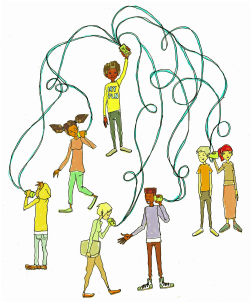
The June Issue of Lifewide Magazine is exploring the idea and practice of Personal Learning Networks. A PLN is a way of describing the group of people that each of us connects with to learn from, and sometimes with. It's personal because we choose the people we want to involve ie we see advantages of being connected to them, and forming and sustaining a relationship with them in order to develop our thinking and capabilities. We also participate in networks of connected people in order to be involved in something and/or to achieve something and learning then becomes a bi-product of our involvement.

Connectivity - is the defining property of the Social Age, and it is central to the idea of PLN's. Forming connections and relationships with people who can help us learn and or achieve something, is part and parcel of being the social animals we are. But the idea of networking for learning has become more important as a result of the new affordances provided by the internet, smart phones and other mobile communication devices, and Web 2.0 and social media technologies. Our PLN is not limited to online interactions, but it is the ability to connect easily with many people from all over the world, in a sustained manner, that makes the social practice of a PLN so powerful. In a world of just-in-time learning the affordances provided by the internet means it is also possible to find people quickly at the point that a problem has to be solved. Such possibilities were simply not available ten years ago.

When we give something a name it defines the way we view it. The words PERSONAL (meaningful to me), LEARNING (the act of gaining new, or modifying existing knowledge, behaviours, skills, values or beliefs) and NETWORK(S) (a group of people we connect to or who are connected to us), clearly emphasise these three ideas but this definition encourages us to ignore other aspects of the concept.

Our PLN’s often assist and enable us to involve ourselves in something, often to accomplish something we value. PLNs and the relationships we build within them are also a way of involving people in our own life projects and for disseminating the results of our learning. In other words they provide a vehicle for participation and for influencing the thinking and actions of others. These dimensions of activity are camouflaged within the PLN concept.

Our PLN's change through time as we move from formal education, into a career, we change jobs, roles and careers or engage in new projects, and perhaps move to new cities or new countries. Because of this our PLN's have both lifelong and lifewide dimensions. Our development through life, it might be argued, is the result of a constellation of PLN's we have created and been a part of tracking the sorts of changes in our circumstances outlined above.

Our PLN’s vary according to types of knowledge we want to access. If we need to learn complex things like ways of thinking, communicating and behaving in a specific field of social practice, we create networks for learning that will enable us to participate in such social practices and gain access to the embodied knowledge of others who are more experienced and expert than ourselves. To some extent we can engage in conversations through which tacit knowledge can be shared through on-line forum’s but such forms of communication will not allow us to observe people in action and appreciate the nuances of their actions in the particularities of the contexts and situations they inhabit. But there is a world of networking through which people share their personal knowledge, insights and experiences through the medium of the internet. It is these computer-mediated networks for personal learning that have extended our scope for PLN’s.

Our PLN's are central to the idea of learning ecologies  'the complex set of relationships we create in a particular context for a particular purpose that provide us with opportunities and resources for learning, development and achievement'. PLNs are like the blood vessels in our body or the roots and capillary vessels of a tree. They provide the relational structure and means of connecting to others and the means of tapping into the medium and nutrients for learning - the flow of information, knowledge and wisdom  within our learning ecology. They connect our ecology for learning with the ecologies developed by others for their learning. So gaining deeper understandings of our PLN's will also help us understand our own ecologies for learning better.

Given that they are so important it is surprising that higher education does little to encourage students to develop and practice the skills of networking for learning: preferring instead to rely on learners assimilating knowledge that has been codified in books. But for most students their future lies in mastering the ability to discover, create and co-create new knowledge to solve their everyday problems in particular situations and contexts. They need to become adept at creating, maintaining and making effective use of the resources contained within their PLN's.

So what might universities do to help students develop 
this important capability for learning and achieving? There are at least three possible strategies.

1) The professional route - universities might emulate the ways in which professionals  working in business and industry develop and maintain their links. A starting point might be to utilise their network of alumni, and involve students in using professional networking platforms like LinkedIn and Academia.edu

2) The subject route - within the programme and the broader social/cultural environment of a department, students could be encouraged to network around social activities, study groups, and projects and assignments that deliberately encourage learners to discover things not only through books but through finding people who can help them.

3) The lifewide route - universities might recognise that students are active networks in other parts of their lives outside the academic programme through which they form PLNs. Perhaps these experiences can be used to explore the idea and practice of networking perhaps in the context of personal development planning?

How important do you feel it is for students to develop their understandings and capabilities for networking and what sort of strategies might or are being used?

Norman Jackson
Founder Lifewide Education

Further reading
LIfewide Magazine June 2015 Exploring Personal Learning Networks (to be published 28/06)


11 Comments

SEEK, SENSE, SHARE : UNDERSTANDING THE FLOW OF INFORMATION THROUGH A PERSONAL LEARNING NETWORK

5/14/2015

9 Comments

 
Picture
I'm working on the next issue of Lifewide Magazine which is exploring the idea of Personal Learning Networks (PLN's) which I take to mean the people we connect to in order to learn from, collaborate with or be inspired by. Bringing each issue of the Magazine into existence is a major driver for my own leaning and related development of ideas and practices. The Social Age (1) has created new affordances for networking and changed the way my own PLN works by enabling me to connect to the imaginations, writings, illustrations and conversations of a multitude of people through social media, RSS feeds, maillists and forums.

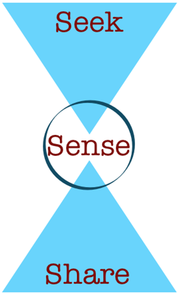
I wanted to connect and integrate my ideas on PLNs with the flow of information and knowledge through my own learning ecology. Using my PLN I discovered the Seek-Sense-Share model of information flow developed by Harold Jarche(2) to represent the way we set out to find information that is relevant to our learning and development projects, make sense and use that information then share with others our understandings.

According to Harold, Personal Knowledge Mastery (PKM) is a framework for individuals to take control of their professional development through a continuous process of seeking, sensing-making, and sharing.

Seeking is finding things out and keeping up to date. Building a network of colleagues is helpful in this regard. It not only allows us to “pull” information, but also have it “pushed” to us by trusted sources. Good curators are valued members of knowledge networks. I think that seeking can be passive -  ie we connect to people, communities and organisations who share their knowledge freely and wait with 'watchful anticipation' for something to emerge that is of interest. And then there is the more deliberate mode where we invest lots of time and energy seeking out information that has the potential to be useful.

Sensing is how we personalize information and use it. Sensing includes reflection and putting into practice what we have learned. Often it requires experimentation, as we learn best by doing. Sensing is about trying to make sense of the information we receive or find. We try to connect it to our own understandings which we may need to alter in the process. It is all about creating meaning and then perhaps learning to use what we have learnt.

Sharing includes exchanging resources, ideas, and experiences with our networks as well as collaborating with our colleagues. Sharing involves gifting our understandings or personal sense making to the world either by making it accessible in publications like magazines, books, papers, blogs, twitter posts and any other open access publication vehicles. It's also about using it in work or other social practices.


Picture
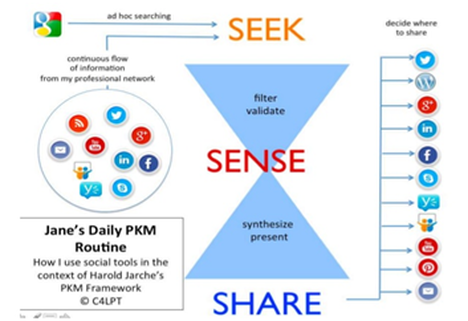
 SEEKING further information on PLNs through my own PLN led me to Jane Hart's excellent blog post(3) in which she described how she had applied the Seek-Sense-Share model to her own daily knowledge management routine. I like this representation as it converts an abstract model into something tangible and meaningful.

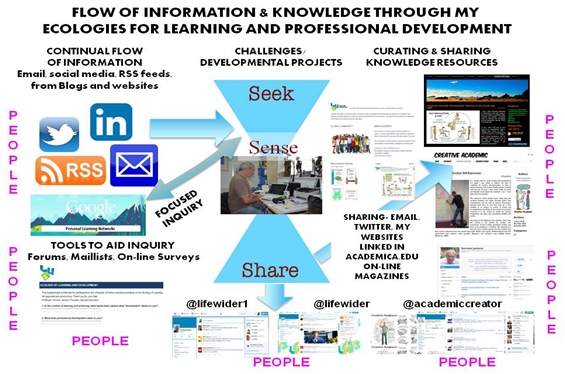
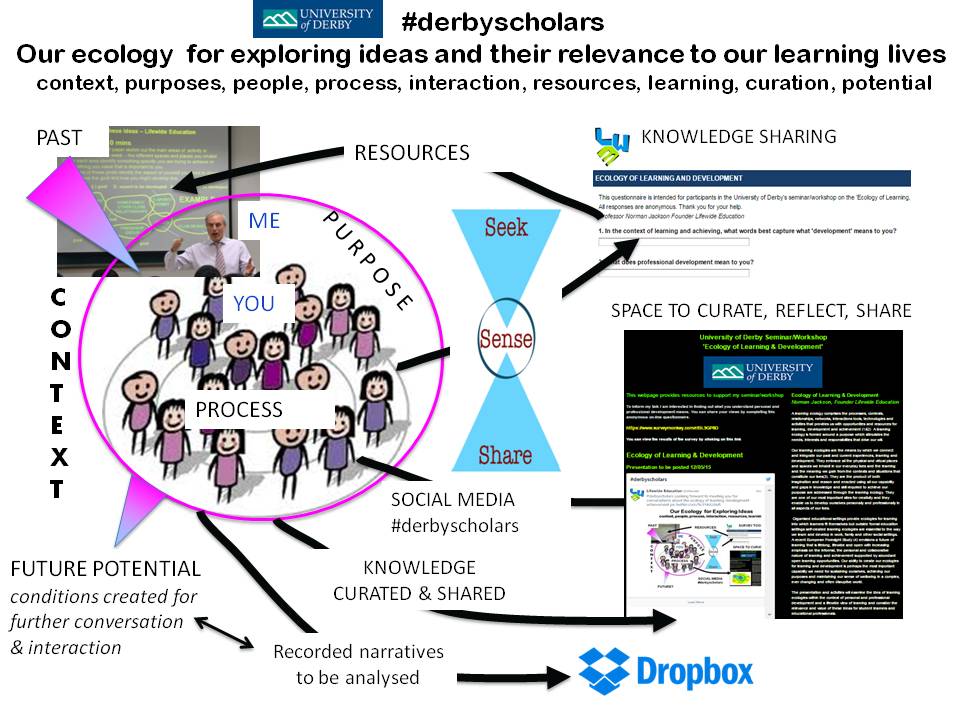
I decided to personalise Jane's approach and the result is shown in the illustration below. Unlike Jane's disciplined daily routine, my approach to accessing the information flow from my PLN is quite chaotic. But it becomes more disciplined and systematic when I want to learn something. I dedicate the time and resources to SEEKING information that might be relevant (such as what I'm doing now) for a particular purpose. In other words, while this model explains the ongoing information flows in my life, it only springs into action when I have created an ecology for learning or achieving something for which I have a need for new information and knowledge (4).

Picture
The illustration represents the flow of information and knowledge through my current learning ecology. While there is a lot of use of technological tools what is hidden from view are the people who make use of these technologies who create, curate and communicate  the information which I receive or SEEK.

I use my PLN to SEEK information in two different ways. The first is to provide me with a continuous flow of information that might be of interest and which I might be able to make use of either now or in the future. The second mode becomes active when I engage with a problem and I actively begin to create an ecology within which I SEEK specific information, and individuals inside or outside my existing PLN, who can provide me with information, relevant to my learning project. This is a transactional relationship in which I commit to SHARING some of what I have learnt with the people who include me in their PLN or who in future engage in their own SEEKING for information that I have shared.

In accessing the information I make a judgement as to its relevance, validity and utility and then I either store it or put it to use by bringing it into my learning project. Through a process of trying to understand and apply the information SENSING, I create new meaning and change my own understandings which I can SHARE via my Twitter accounts or through my websites, connections to mail lists or through on-line publications, with other people will be interested. The value of CURATING as part of the infrastructure for sharing is that it provides a context to enable deeper understandings to be made. This in turn stimulates interest and new exchanges with people who I may then include in my PLN.


The SEEK SENSE SHARE model also works well for more dynamic learning ecologies such as a teacher working with her students might experience. For example, while writing this article I facilitated a workshop on the theme of Ecologies for Learning, Development and Achievement. I created a learning ecology in which SEEKING involved inviting them to complete an on-line survey the content of which was included in my presentation. Also during the workshop participants shared their narratives of learning ecologies that they had created and these were recorded for analysis after the workshop. SENSING involved processing the information and narratives I had been given and then the results of this process were SHARED with participants and the conversation continued. 

Picture
I conclude that Harold Jarche's SEEK SENSE SHARE conceptual tool for visualising the flow of information to, through and from a learning ecology seems to work very well in these contexts.


References

1 Stodd J Exploring the Social Age and the New Culture of Learning Lifewide Magazine Issue 11 September 2014 http://www.lifewidemagazine.co.uk/2014.html
2 Jarche H, (2014) The Seek > Sense > Share Framework Inside Learning Technologies January 2014, Posted Monday, 10 February 22 014  http://jarche.com/2014/02/the-seek-sense-share-framework/
3  Hart J (2013) My daily PKM routine (practices and toolset)
http://www.c4lpt.co.uk/blog/2013/11/30/my-daily-pkm-routine-practices-and-toolset/             

4 Jackson, N. J. (2013b) Learning Ecology Narratives, in N. J. Jackson and G. B. Cooper (eds) Lifewide Learning, Education and Personal Development E-book Chapter C4 available on line at: http://www.lifewideebook.co.uk/research.html


Norman Jackson
Founder Lifewide Education
9 Comments

Exploring Reflection in the Social Age

3/31/2015

3396 Comments

 
Picture
Helping to bring an issue of Lifewide Magazine into existence is one of the most powerful tools I have for making me think reflectively, analytically and creatively. The fact that each issue explores a new theme drives my learning and ultimately the development of my thinking, and what I learn causes me to reflect on what I thought I knew before.

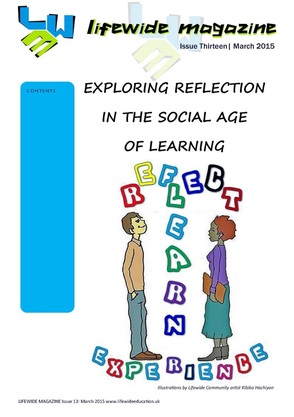
Issue 13 focuses on reflection - more specifically on how we reflect in the age of social media.To be honest, I never thought much about reflection in educational practice until I got involved in helping to create a policy that would encourage and support the introduction of Personal Development Planning (PDP) into higher education. I soon realised that PDP would become a vehicle for systematically embedding reflection in the educational experiences of all students in UK higher education.

Picture
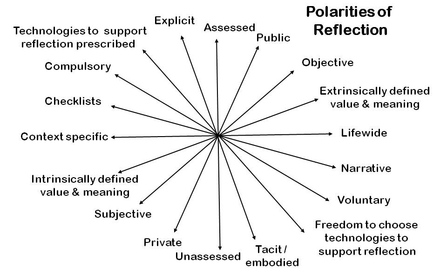
Reflection is aided by tools that help us think. Almost anything can be used as a tool but for me I find pictures, diagrams or illustrations particularly helpful. A few months ago I read 'Engaging Imagination' by Alison James and Stephen Brookfield (1) which opened up a lot of my thinking about reflection. But I found one diagram on pg 45 particularly helpful. It showed what they called the polarities of reflection - 'the binary tensions that may exist in respect of student reflection' and the need to balance these different polarities if we are to create opportunities for students' reflective thinking. I adapted their diagram to add a few of my own polarities and make it meaningful for my own purposes. It made me think that in trying to navigate and make sense of the complexity associated with reflection in higher education learning and educational practices, perhaps we are mixing up a lot of different binary tensions and polarities inherent in reflection.

Picture
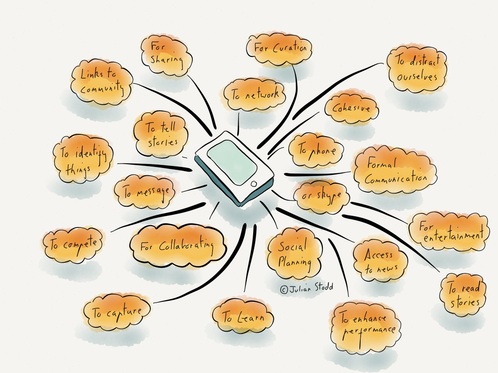
Issue 13 continues to explore the idea of the Social Age (2) which is undoubtedly making life more complex by expanding the means and opportunity for communication and reshaping our engagement with information, learning and the production and sharing of knowledge. But how is the Social Age impacting on our ability or inclination to reflect? Is the space for reflection diminished as the flow of information increases? The Social Age is all about increased connectivity so is reflection becoming more social? We now have a wealth of web 2.0 and social media tools, so are we better able to record our thoughts, create new meaning and share our understandings using these technologies? Are we able to represent and interrogate our experiences and understandings in new ways? Or is reflection in a connected public world more about presenting oneself favourably rather than critically evaluating and understanding ourselves better? What is the balance between the private and the public, and between the judgemental worlds of accountability and the freedom to deliberate and express ourselves? These are all interesting questions for this and future issues of Lifewide Magazine to explore.

Everyone reflects, it's an important part of what makes us who we are and helps us sustain our beliefs and confidence. It enriches our capacity to learn from our experiences but much of it goes unnoticed as we go about our daily lives.  Reflection is an integral part of our self-regulatory mechanism for ensuring that we survive and thrive. But in many professional roles we have turned reflection into an instrument for accountability and perhaps, in the process, given up some of the freedom and intrinsic motivations we have for exploring our experiences, our practices and ourselves. We have to be very careful in higher education not to stifle intrinsic desires for reflective space and the need for the continued development of personal narratives, through efficient, mechanistic exercises that reduce everything to tick box answers.

In UK higher education we have embedded and systematised reflection in the practice of Personal Development Planning which has been implemented in many different forms over the last fifteen years. Rob Ward, who has made PDP his life project, asks the question, 'what impact is the Social Age having on PDP practice?

Reflection is inherently about creation since we create new understanding through the thinking process that causes us to pay attention to the detail of what we have learnt in one situation, that might be applied in future in another situation. The new insights we gain through reflective thinking gives us the confidence to put ourselves into new unfamiliar situations which in turn will demand our creativity. Furthermore, reflective thinking may motivate us to make artefacts to record or document our experiences and represent our learning for example in diaries, scrapbooks and blogs, and this perhaps is where social media plays an increasing role.


Picture
Picture
Some thoughts on reflection in the Social Age

Most people reflect on experiences and events in their lives but they do so privately, informally and without a record. This general tendency carries over into the use of social media - even active users of social media typically do not use these media for recording self-reflection. So being an active user of such media does not in itself mean that people will use their affordances for reflection and recording reflective thinking. People who voluntarily record their reflective thoughts, in a diary, letters, blogs and through other means, do so because of the intrinsic value and meaning they derive from the process. For them reflection is a part of who they are and an outlet for their creative self-expression. They will search for and use the medium(s) that enable them to best express their reflective thoughts in words, drawings, paintings, photographs, making things. If they use social media then they will consider the affordances they offer.

Generally,  people spend time and effort recording their reflective thoughts only when they are expected or required to do so. For example, in work reports, training and development activities or appraisal procedures, or in formal educational processes. They might also reflect and record their thinking at important transitions in their life for example when they are considering leaving a company or applying for a job and they have to update their CV or write a letter of application. In other words reflection is fulfilling a particular purpose and the parameters are usually externally defined. People engage in reflection when they are involved in learning projects, CPD activities or a new and rich informal learning experience, such as travelling or living in a new country. They might also engage in reflection and recording their thinking for therapeutic reasons for example following trauma.

The people who do spend time and effort recording their thinking, including their reflective thoughts, over sustained periods of time, are people who are interested in and committed to their own learning and development. Typically such people are involved in the development of others - teachers, trainers, coaches, educators, developers and one of their purposes is to lead by example by showing the value of recording their reflections.

In addition to people who are directly involved in education, there are groups, such as Professional Bodies, that have a particular interest in promoting formal reflection through their role in professional recognition and the maintenance of  good standing through self-managed CPD. This connects reflective practice in education with reflective practice in the professional world.

Yet another group of people who record their thinking in a publicly accessible way are the thought leaders and writers, who want to influence others, build their reputation and promote themselves in the process.

You have to be an active user of social media in order to make use of its affordances for supporting reflection. Personal blogs using web 2.0 platforms like wordpress, tumblr and weebly, are the preferred social media tools for making reflective thinking publicly available - often supported by Twitter. But people who are highly involved in social media make use of many different tools in their reflective processes, curation and sharing practices. It's also clear that some people have tried to use social media to encourage reflection and have been disappointed with the results. These tools did not help them reflect deeply and meaningfully.

Virtually, all the contributors to Issue 13 of the Magazine maintain a blog through which they publish, amongst other things, their reflective thoughts. Their blogs are connected to their purposes - usually their role, specific aspects of their work or other enterprises they are involved in or perhaps their passions.

So on balance, it would appear that social media provide a medium for recording and presenting reflective thinking for those people who want to reflect and are interested in using such media to accomplish this. But it probably has little impact on people who do not see the value in recording their reflective thoughts.

But we must also be aware that reflective thinking that is publicly shared through social media reveals only part of an individual's reflective story and its purpose is primarily not to codify the learning of the individual for themselves but to present such codification to others.

In providing me with some useful feedback on my article, John Cowan highlighted the fact that people rarely admit mistakes/failure or messing up in their blogs preferring to present themselves in a more successful light. Whilst  I agree with this generalisation I don't think its all that different to reflective writing in an assessed portfolio be it for claims of student or professional learning. Unless of course people deliberately set out to focus on critical incidents and mistakes.

I don't encounter many blogs or diaries or social media postings that record mistakes, weaknesses or causes for worry, except when they also record that the writer has these in hand.  When I read such entries, I find myself asking myself, "What is this writer trying to sell me about himself or herself? And why?" Me, I reflect for me.  On the many occasions when I make these efforts available to others, I am simply trying to share with them that this man can and has found it useful to be personally probing in frank reflections. Professor John Cowan (pers comm)

Regardless of whether we perceive social media to be of use in personal reflection, social media are good at helping us share our reflective stories and insights. When I start researching a new topic I will often search for blogs where people have shared their own thinking and ideas. By sharing their creative contributions people help other people to think: people they will never know unless they make a comment on their blog. Seeing someone else make use of your thinking and creative products can be highly motivating and encourage you to share even more - but all too often people do not leave comments so we do not know what effect our sharing has.

But to be brutally honest I rarely receive any comments on blog posts and my most successful engagements which foster reflective dialogue have been through email, where I have invited someone I trust to provide me wi h their perspectives on thoughts I have shared.

Picture
No Room for Reflection

It is also worth reflecting on the very real danger, in a world where people are constantly immersed in using technology and constantly consuming and creating media products, that time for and interest in reflection gets squeezed out. Perhaps also much of the information flow is designed to encourage us to accept the message without critique. So what is the point of having new affordances for reflection if our desire to utilise those affordances gets overwhelmed or surpressed by other possibilities: possibilities that are perhaps more enjoyable to enact than reflecting on past experiences, some of which might be far less enjoyable to relive.


As Marsha Bernstein (4) so eloquently puts it - 'there is no app for knowing yourself'8. Her concerns in a world of constant social media consumption is that her children have little time or inclination to be 'alone with their thoughts and feelings -- the happy ones, the dreamy ones, the uncomfortable ones, the ones they want to get away from. Those moments that allow us to get to know ourselves, all parts of ourselves, not just the likes and dislikes or how our Facebook profile pic looks. How will they engage in any self-reflection or inner mining if they're in a constant loop of Vine videos and Starbucks selfies?'8

For those of us who have learned the value and necessity of reflective habits I suppose we are all learning how to design and manage our lives in the new social order and it might take time for us to adjust and understand how social media and other web 2.0 technologies can best assist our reflective thinking processes.

For those who have yet to discover the value and necessity of reflective habits we need to recognise that in spite of the many wonderful opportunities and affordances web 2.0 and social media provide, it is still important to help learners develop the skills and attitudes that will help them develop the habit of creative and critical reflection.

But ultimately, and regardless of technological innovation, and whether we record or do not record our reflective thoughts, we all need to find the time and space to think and explore and challenge our own beliefs, assumptions and prejudices in order to become the sort of person we want or need to be.

Picture
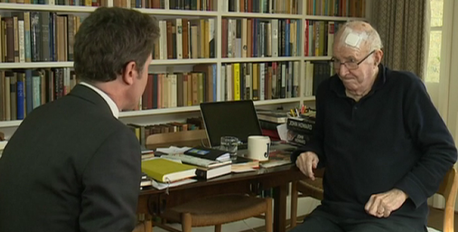
(I think I will leave the last word to Clive James who was on breakfast TV this morning.  He has been fighting terminal cancer for the last five years. He has written a series of poems reflecting on his life including 'Sentenced to Life' in which he looks back on his life and candidly reveals his failures and regrets.  He said, 'The mistakes are the only things we learn from, nobody learns from success, but your failures are a real subject'.  The interviewer read a verse from one of his poems..

Leçons De Ténèbres
But are they lessons, all these things I learn
Through being so far gone in my decline?
The wages of experience I learn
Would service well a younger life than mine.
I should have been more kind. It is my fate
To find this out, but find it out too late.

In the conversation that followed, Clive James admitted, 'I wish I had been wiser earlier,  but now that I am being as wise and comprehending as I can be about my life. I have something to go on, to be grateful for.' Through sharing his thoughts he provides us with a glimpse of how reflection features in the later stages of our life as we look back and think about what might have been, but are thankful for what has been. This is one reflective process the Social Age will not change.


Acknowledgements
My thinking greatly benefited from conversations with Professor John Cowan, Chrissi Nerantzi and Sue Beckingham. You can access Lifewide Magazine at 
http://www.lifewidemagazine.co.uk/

Reference
1 James, A. and Brookfield, S. D. (2014)   Engaging Imagination: Helping students become creative and reflective thinkers Jossey Bass
2 Stodd, J. (2014a) Exploring the world of social learning. Smashwords Available at:
     https://www.smashwords.com/books/view/204432
3 Stodd, J. (ed) (2014b) Lifewide Magazine September 2014 Exploring the Social Age and the New Culture of Learning Available on line at:  http://www.lifewidemagazine.co.uk/
4 Bernstein M (2014) Knowing Yourself: There's No App for That. Huffington Post
http://www.huffingtonpost.com/marsha-lebedev-bernstein/knowing-yourself-theres-no-app-for-that_b_6057042.html

Interview
BBC Breakfast TV interview with Clive James 31/03/15 06.53am
http://www.bbc.co.uk/iplayer/live/bbcone


3396 Comments

The profound importance of disruption & inflection in our learning lives

12/29/2014

6 Comments

 
Picture
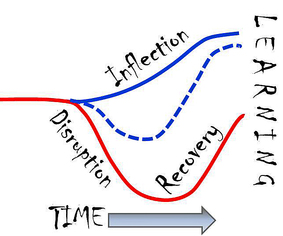
The process of writing, editing and curating  Lifewide Magazine (1)  is an enormously powerful agent for reflection and I find myself thinking about my own life in ways that I have either never thought about before. In my research for the December 2014 issue I came across an article that described an interview-based study in which participants had been asked to identify seven significant events in their life and then construct a narrative of their life using these events as a structure.  Inevitably, events that were chosen were times of significant change. I tried the same approach and came up with eighteen events over my lifetime that either caused me to create a new or modified pathway though life and/or changed my behaviour in a significant way which meant I changed my attitude and approach to life and therefore lived it differently. Through this process I identified two different types of life changing events which I'm calling inflections and disruptions.

Picture
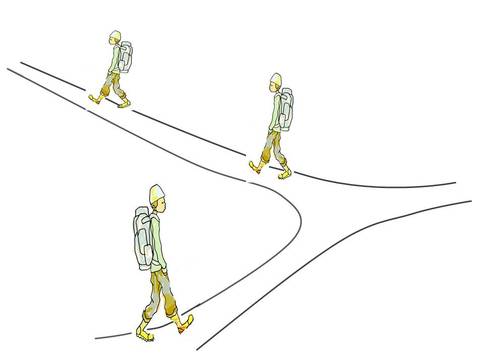
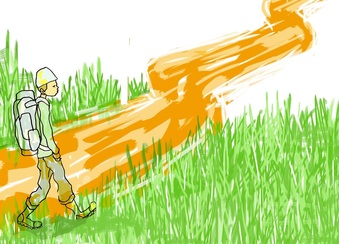
Inflections are points in your life where events and decisions take you in a different direction, altering the course of at least one aspect of your life - like education, a job or relationship. Characteristically they engender positive feelings of hope, adventure and opportunity as you are propelled into and along a new trajectory. They require you to go through a transition which may or may not be easy to make but the transition is generally accompanied by feelings of excitement and interest about what might be rather than a sense of loss for what has been. Applying for, securing and settling into a new job are important inflection points in life, in so far as they provide new contexts for experiences, social interaction, problem solving and challenges and require transition which impacts on identity, confidence and capability.

Picture
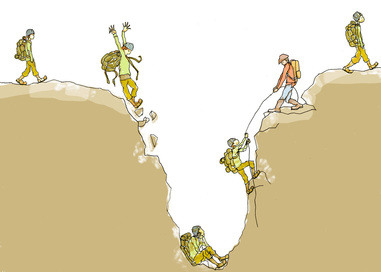
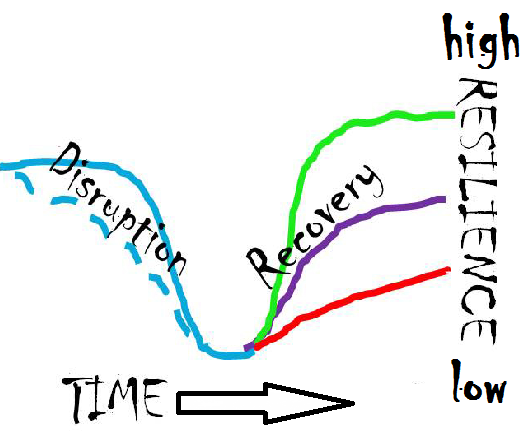
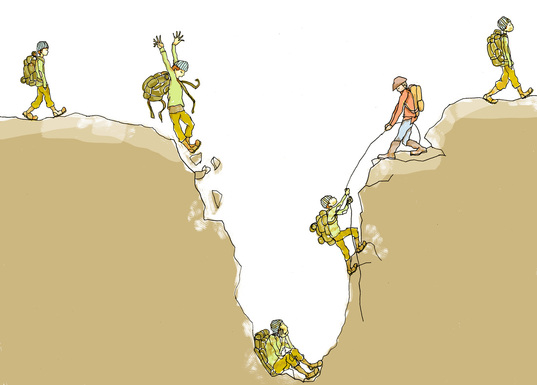
Disruptions, on the other hand, are events that are either thrust upon us by circumstances beyond your control - like serious illness, injury and death, or new situations that you voluntarily enter - like ending one career and starting another, or moving overseas to begin an entirely different life. Significant disruptions require us to go through a process of transformation that engender a deep sense of loss as you leave something of yourself behind and try to adjust to new unfamiliar situations and an uncertain future. Disruptions are psychologically more disturbing because emotions are more negatively charged and they often pose significant challenge to our sense of who we are and are likely to require considerable resilience to overcome them.

Picture
APPLYING THESE IDEAS TO MY OWN LIFE 
Like most people, I have experienced many more inflections in my life than disruptions.  I came up with a list of 14 inflection points and 4 significant disruptions.

Inflection points occurred three times during my secondary schooling and on each occasion there was a circumstance in which a teacher believed in me sufficiently to give me a chance and help create opportunity for me which took me on a new pathway without feeling any sense of loss for the past. Inflection points in my life also determined my pathway to a PhD and to my first professional role and 8 years of living in Saudi Arabia. At a personal level, inflection points occurred when I met the first girl who I decided to marry, and also, after her untimely death at the age of 48, when I met and married my second wife and entered her family. Inflections also occurred as each of my children were born and we grew from a couple into a family since becoming a parent and caring for children has a significant impact on our experiences, identity and behaviours.

"Very few people see inflection points as the opportunities they often are: catalysts for changing their lives; moments when a person can modify the trajectory he or she is on and redirect it in a more desirable direction.  Whether it's a new job, a change in a relationship, or something else, an inflection point is one of those periodic windows of opportunity when a person can pause, reflect, and ask: '... do I want to continue on this path or is now the moment to change direction?"(2)

It's hard to remember what you thought as a child, but now I think I did realise at the time (aged 12) when I was in my first inflection point, that I was at crossroads and that the decision I was making would alter the course of my life. I could see that there were opportunities for me to take although I could only appreciate the true significance of the change I made when I look back years later. As Soren Kierkgaard once said 'Life can only be understood backwards [after it has been] lived forwards'

Turning to the disruptions in my life I have experienced several of my own making. The first occurred when my family and I left Saudi Arabia and I gave up a job I enjoyed, many good friends and a lifestyle we had grown accustomed to come back to a period of great uncertainty. The second, when I was 40, and I fundamentally changed my career. The first 12 months were the hardest of my professional life. I had to give up being the professional geologist I had invested heavily in becoming and there were enormous feelings of loss alongside the stress, uncertainty and at times exhaustion I was experiencing. But the biggest disruption I have so far had to cope with was the loss of my first wife to cancer in 1999. When she died, a significant part of me died with her and I know that I became a different person to the person I was when she was alive. While outwardly it might have looked as if I had coped well with my loss, I mostly kept how I felt to myself. I lost my enthusiasm for life for a while and within a few months I had decided to move on to another role in another organisation - I think, in part, to escape the past.

Looking back now, I can now see how all these inflection points and disruptions were the triggers for new pathways and experiences through life. Many of these points required me to go through a transition that was not enjoyable or comfortable and was sometimes full of anxiety and stress. All of them changed me to varying degrees and in various ways. All required me to learn, develop and change as a person. Many required me to develop myself professionally for new roles and to relinquish an identity and begin to form a new identity. 

THE IDEA OF LOSING YOURSELF
As I was completing this post I came across a post by Maria Popova (3) on Rebecca Solnit's book A Field Guide to Getting Lost (4). Maria tells a story in which a student came into a workshop with  a quote from what she said was the pre-Socratic philosopher Meno. It read, “How will you go about finding that thing the nature of which is totally unknown to you?” The idea of using disruptions and inflection points in life to discover how to 'go about finding that thing, the nature of which is totally unknown to you', seemed like a revelation to me.

Solnit writes (4): 'To lose yourself: a voluptuous surrender, lost in your arms, lost to the world, utterly immersed in what is present so that its surroundings fade away.' As  Popova elaborates,'to be lost is to be fully present, and to be fully present is to be capable of being in uncertainty and mystery. And one does not get lost but loses oneself, with the implication that it is a conscious choice, a chosen surrender, a psychic state achievable through geography. That thing the nature of which is totally unknown to you is usually  what you need to find, and finding it is a matter of getting lost.' This beautifully expressed way of seeing the process of embarking on a new trajectory through life, seems to offer a deeper insight into the psychological process of life inflections and self-disruptions, by revealing why we are motivated to do it.  By changing the direction of our life. By voluntarily putting ourselves into new situations that will take us on a different path through the landscape that we have access to in our life - we are creating opportunity to lose something of ourselves (the life we used to lead and the person we used to be) while at the same time creating the potential to discover, 'that thing, the nature of which is totally unknown to you'.  Losing ourselves is the way we challenge ourselves to live a life in which we can discover for ourselves who we are.  'Never to get lost is not to live' (Popova).

NEW OPPORTUNITIES FOR CREATIVITY 

It seems to me that inflections with all the promise they hold, are also important points for creativity as we have to recreate ourselves and develop entirely new ecologies for learning and flourishing in response to the changing circumstances of our life. On the other hand disruptions are often periods when creativity may die within us as our desire to flourish is overwhelmed by our sense of loss and dislocation, and creativity serves only to help us survive, not flourish.

I conclude that the points of inflection and disruption in our life enable us to discover who we are at each stage and in each part of our life and they exert a profound influence on who we become. They are largely responsible for our uniquely personal learning and development trajectories and our accomplishments in the contexts we have inhabited. They demand and require us to develop our resilience and afford us new opportunities to exercise our creativity in both recreating ourselves and solving the problems and dilemmas of new circumstances in our life.

Sources
1) Exploring Disruption and Resilience Lifewide Magazine December 2014           
2) Taking Advantage of Life’s (Few and Far Between) Inflection Points  Howard's Gift: Uncommon Wisdom to Inspire Your Life's Work,  By Eric C. Sinoway http://hbswk.hbs.edu/item/7041.html
3) Maria Popova (2014) A Field Guide to Getting Lost: Rebecca Solnit on How We Find Ourselves 
4) Rebecca Solnit (2006) A Field Guide to Getting Lost: Rebecca Solnit on How We Find Ourselves

Illustrations by Kiboko HachiYon


6 Comments

Exploring Disruption and Resilience

12/18/2014

10 Comments

 
Picture
Regardless of the era we inhabit, people have always been challenged by disruptive life changes: changes that disrupt the patterns, routines and relationships of everyday life and cause us to adapt our life or create an entirely new  life for ourselves and perhaps reinvent ourselves in the process. These profound changes may be forced upon us or they might be chosen because our circumstances dictate that change has to be made.

After spending a few minutes thinking about my own family and  friends I concluded that our lives are full of disruption. Mostly small disruptions that we can skirt around by adapting plans, some a bit bigger that cause us to abandon or re-write plans and a few, that change the direction of our whole life.

In my adult life I have experienced several that caused me to abandon and re-write my life plan including - leaving the UK to work in a culture that was very different to my own and then eight years later leaving that country to start all over again in the UK, changing careers in my early 40's and then being made redundant from a job I liked two years later, the loss of my first wife to cancer and experiencing other serious illnesses within the family, and transitioning into that phase of life after fulltime employment that is called retirement. Looking around me I can see similar life-changing disruptions and stresses in the lives of my children, parents, siblings, relatives and friends. 

Such life-changing disruptions upset life's routines and may, in some cases, erode or even destroy our identity, our family, our economic viability, our mental and physical wellbeing, our enjoyment and enthusiasm for life. In extreme cases they can make us want to give up on life altogether. Such disruptions breed uncertainty and anxiety and affect our relationships with people who are close to us. They are a test of our character, fortitude and resilience - our ability and will to fight back, move through and beyond a transition and progress into a different but more stable and sustainable existence.

Disruption is a fact of life, something we have to learn to cope with or we may become disabled by it. However uncomfortable, painful and difficult somehow we have to come to terms with the disruption - confront the new reality - and find a pathway to a different life. There is no turning the clock back: once it has happened we can only move on into a life that is different and mourn the loss and appreciate what we have and any opportunity we have been given.

Learning to cope with, move forward or 'bounce' back from disruptive is a lifelong - lifewide challenge: a challenge that is becoming more common in the Social Age as the speed of technological change forces people to change their career/work pathways more frequently.

Disruptions to our lives can occur at any time and can originate from many sources and an infinite number of personal circumstances. Significant life disruptions can be health related - serious illness including mental illness and loss of memory, and serious accidental injury,  or the birth of a child with a disability, all of which can affect self or family members that impact on you. They can be related to the loss or disintegration of personal relationships - like the loss of a child, sibling, partner or parent, or the loss of a very close friend, and the splitting up and separation of partners and their families.  Or from a child's perspective the loss of, or removal from, their parent(s) and being taken into care or being fostered.

They can be related to work especially the loss of a job, or serious stress within a job that causes someone to become unable to do their job. The loss of employment can lead to financial hardship which could spawn many more problems including going into debt or even the loss of a home.

For children, teenagers and young adults work equates with study at school, college and university and serious stress, bullying or significant academic failure can all result in the disruption of life.


Picture
Significant transitions in life are also potential sites for disruption. The very idea of transition suggest a journey from one sort of life to another. Transitions are often complex. They can affect different people in different ways, at different times, and for different reasons. Multiple interrelated transitions may also occur concurrently or in succession. There are some transitions that are almost universal, being experienced by most if not all people in the UK; some that usually result from unforeseen and/or unintended events but which may be short term and relatively recoverable; and others that are experienced by a small number of people and often associated with a longer term negative pattern or cycle – the revolving transitions. 

A significant life disruption might be the result of a single event like birth, a stroke or a serious accident or it might result from a process in which events and circumstances coalesce - like stress at work leading poor performance and the loss of a job leading to financial hardship, serious debt and the eventual loss of a home, relationship problems and the splitting up of a family. These might seem like extreme scenarios but they illustrate how one sort of disruption or circumstance can grow into another and another.

All significant life disruptions affect the whole of life not just the future but all the parallel lives that are lived by an individual in the past and present. They may affect personal relationships, work, hobbies and interests and physical activities. They may impact on all the things we want and need to do in everyday life. Serious disruptions that affect our functioning and leave us disabled in some way reduce our lifewide experiences. In extreme cases - like hospitalisation through serious illness of injury, they reduce the identities we hold in different parts of our lives to a single identity and experience. Transition through a significant disruption may entail replacing our existing set of lifewide experiences with an entirely different set of lifewide experiences, developed in new contexts over a period of time.

All significant life disruptions result in loss of some aspects of our self which may cause manifestations of grief and the eventual rehabilitation and alteration of self. If the self wants to continue to live their life as fully as they are able, the self is required to go through a process in which a new self is created: a process that also requires the giving up of a former self. We define ourselves in terms of the relationships we have and serious disruptions will affect these so our loss of identity is compounded by the loss of the relationships that give our life meaning.

The extent to which individuals are able to rebuild their lives or reinvent themselves will of course be dependent on the individual, the cause and nature of the disruption and the individual's circumstances. The process of re-creation raises the issue of how do we recreate ourselves? How do we learn to be a different person in circumstances that are not our choosing? Some people have the agency and determination to extricate themselves from whatever has disrupted their life and move on to a new life by themselves. But often, situations become so complex that people need help to stabilize a situation and then to rebuild their life. Such help can take many forms - the support of spouses, children, parents, siblings, friends and employers, support from specialist services - like health and social care, public and voluntary sector agencies offering advice and support, and educational services that enable people to develop themselves, and increasingly in the Social Age - on-line communities and forums where people can gain support and advice from others who have had similar experiences and who are willing to share their personal knowledge to help others in need.

The issue of disruption is an important issue for lifewide learning because it creates new and significant demands and challenges for learning and development and sometimes completely reshapes our lives and who we are. Yet formal education steers well clear of disruption. In fact formal education tries to create an environment that is totally devoid of disruption. Perhaps such avoidance is not in the interests of young people who are preparing themselves for the rest of their lives in which they will have to learn to cope with all manner of disruptions.

Because we think it is important to consider the effects of disruption on people's lives we have devoted Issue 12 of Lifewide Magazine to exploring the ideas of disruption and resilience.In reading some of the contributions I was struck by how often the very idea of what learning means is questioned and challenged in the context of disruptive life change. It often comes down to 'learning to be' all over again. Having spent a lifetime learning to be someone, serious disruption can cause us to start learning to be an entirely different person. We often talk about education enabling people to reach their full potential. But what if that potential is taken away from you during course of your life and replaced by a different potential? I am curious to know how our education systems might help develop people so that they are better able to cope with such profound and disturbing realities.

TO EXPLORE THESE IDEAS FURTHER PLEASE READ ISSUE 12 LIFEWIDE MAGAZINE


10 Comments

Using the cynefin framework to make sense of Life's Disruptions

12/17/2014

2 Comments

 
Picture
The editorial team is working on the next issue of Lifewide Magazine  which aims to explore the idea of disruption in life and how individuals cope with and overcome significant disruption and change, adapt and grow through their experiences. The human condition is to try to understand situations in order to make good decisions about how to act or not act. Some situations are easy to comprehend: they are familiar and we have dealt with them or something like them before and we are confident that we know what to do. Others are more difficult to understand and some are impossible to understand until we have engaged in them. The amount of stability will vary from one person's life to another. Instability leading to disruption is not something that can be controlled, and there are many things in life that we have little or no control over. But some aspects of our life we can control and we can actively seek stability by avoiding putting ourselves in situations that might lead to disruption. We might hypothesize that people who behave conservatively, who do not take risks or venture into situations of uncertainty, are less likely to encounter self-created disruption. But also perhaps, they are less likely to be able to deal with it when they encounter it. On the other hand, people who go looking for adventure and change, who are willing to take risks, are more likely to encounter self-created disruption in their life. And because they have experienced it before and dealt with it, they are better able to cope with it should it happen again.

This post is concerned with how we might understand stability, change and disruption in our personal life using complexity theory to help us appreciate what is happening and why it is happening. Complexity theory is 'a set of concepts that try to explain complex phenomenon not explainable by traditional cause and effect theories. It integrates ideas derived from chaos theory, cognitive psychology,computer science, evolutionary biology, general systems theory, fuzzy logic,information theory, and other related fields to deal with the natural and artificial systems as they are, and not by simplifying them (breaking them down into their constituent parts). It recognizes that complex behaviour emerges from a few simple rules, and that all complex systems are networks of many interdependent parts which interact according to those rules(1).

Interpreting life disruptions using the Cynefin framework

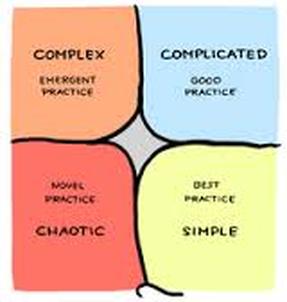
The Cynefin sense making framework, developed by David Snowden (2&3) is a simple tool to help us explore and appreciate the nature and level of complexity in any situation. It was originally developed to aid understanding of organisational change, but the conceptual tool can also be used to evaluate personal situations. A life is after all made up of many situations of differing levels of complexity all being enacted in real time. Fortunately, for most of us, most of our life is made up of situations that are fairly stable and we can reliably predict what will happen within such a situation and we can behave accordingly. We are not challenged to invent new behaviours or learn new things in order to act appropriately and effectively.

Disruption occurs when events and circumstances cause the patterns, routines and relationships of everyday life to fundamentally change and we are forced to relinquish our existing life, or significantly adapt it, or invent an entirely new life for ourselves and perhaps reinvent ourselves in the process. In such situations we are we are challenged to invent new behaviours and learn new things in order to act appropriately and effectively.

Watch a youTube clip about the Cynefin framework developed by David Snowden https://www.youtube.com/watch?v=N7oz366X0-8

There are four domains within the Cynefin framework which we might equate with different types of situation in our life. In the simple domain things have a simple cause and effect – you do X and you are very likely to get Y. The environment - contexts and problems - are familiar and understood. You will probably have had many similar experiences that can be directly related to the situation. You know that ‘what you do’ is likely to have a particular result. And if you do the same thing in a similar situation the same result will happen. This is the situational domain we most commonly experience in our everyday life when life is not so troublesome. In this situation we know what to do, we know how to respond because we have been there many times before.

At the other extreme is the chaotic domain where there is no perceivable relationship between cause and effect. If this situation happens in your life, you feel totally out of control and overwhelmed physically, intellectually and emotionally. We encounter this out of our depth, never experienced before, situation in some life changing experiences. In these situations we sometimes do nothing, either because we do not want to exacerbate the situation or we feel so overwhelmed that we can't imagine anything we do will beneficially affect the situation. Alternatively, we may feel that we have to act, believing that it is better to do something than nothing. In fact it is only by doing something and seeing the results of what we do that we know whether what we did was effective. The feedback we get from our actions enables us to see what we need to do next. It's a trial and error suck and see, who can help me process. It won't get us out of chaos but it may well take us one step in the direction we need to go.

Between these two extremes there are two other types of situation depicted in the Cynefin framework.

Complicated situations are not single events but involve a stream of interconnected situations linked to achieving a goal, like solving a difficult problem or bringing about a change in one's life. An example might be the way someone searches for, finds, applies for and eventually, after a long recruitment process, manages to secure a new job which will bring about a significant change in their material circumstances. Searching for, finding and buying a house might also fall into this category of life challenge. In such situations there are cause-and-effect relationships but sometimes you have to invest effort into working out the relationships by gathering information about the situation and analysing it to see the patterns and look for possible explanations of what is happening. Engaging in these sorts of challenges is the way we become more expert in achieving difficult things, including finding a job and being a parent with teenage children who are trying to find a more independent life.

Complex situations are the most difficult to understand. They are not single events but involve multiple streams of variably connected situations linked to achieving a significant change or, in the context of life disruption, a collection of situations that have coalesced and conspired to make a situation very messy and difficult indeed. In their article Jan Gajeel and Keith Chandler (4) describe life scenarios where a severe illness, leads to depression, leads to loss of job, leads to economic problems and perhaps loss of home, leads to relational problems in the family or the loss of job leads to economic problems, leads to health and social problems like clinical depression and family problems; a divorce leads to loss of family identity, leads to a depression, leads to loss of job. These are complex and very messy situations that may tip people into chaos and without help, few people are able to create a new and better life for themselves. In such situations the cause-and-effect relationships are so intermingled that things only make sense in hindsight and sometimes well after events have taken place. The results of action will be unique to the particular situation and cannot be directly repeated. In these situations relationships are not straightforward and things are unpredictable in detail. People involved may not know the cause of the change that they have been involved in or ascribe the source of change to something that is quite removed from the trigger for change. The way you make progress in understanding what is happening is to sense the patterns of change and respond accordingly. This is exactly where the construction of narratives can help especially if the process is aided by a trusted empathetic facilitator.

Learning for a Complex World

I like the idea of learning for a complex world (5) because it embraces learning and development needs for a lifetime of working with complexity rather than merely studying to pass exams.Traditional academic forms of higher education are founded on stability and certainty and seek to control learning and development within prescribed outcomes-based models of education. They work predominantly with abstract book knowledge and theoretical approaches to problem working. In terms of the Cynefin framework higher education tends to position learning in the simple and complicated domains. Consequently, these forms of education do little to prepare people for the really significant disruptions they will face in their life. Formal education can equip us with knowledge, understanding and ways of thinking that can assist us in particular contexts but it is limited in so far as it cannot offer us the experiences of actually dealing with complex situations as they emerge in the social world that is our life outside the classroom.

The real educational challenge for higher education is to help learners prepare themselves for the disruptions, some forced some chosen, that they will undoubtedly encounter in their lives. In helping learners develop the knowledge, capability, creativity, will and resilience to deal effectively with the full range of life situations we are developing their ability to comprehend and appraise situations of different levels of complexity, and act appropriately and effectively. We do this intuitively throughout our lives because that is what life is about. It stands to reason that a university that adopts a lifewide concept for learning and development (6) extends the opportunity to engage students with the situated and contextualised environments in which such complexity emerges. That is why institutions that seek to encourage learners to draw on their whole life experience for their own development are moving in the direction we need to go if we are to create an education system that will really help people prepare for their uncertain and unknowable futures.

Biographic Note: Norman is the founder and leader of Lifewide Education

Information sources

1http://www.businessdictionary.com/definition/complexitytheory.html#ixzz3IvgHzpZ8

2 Snowden, D. (2000) Cynefin, A Sense of Time and Place: An Ecological Approach to Sense Making and Learning in Formal and Informal Communities. Conference proceedings of KMAC at the University of Aston, July 2000 and Snowden, D. (2000) Cynefin: A Sense of Time and Space, the Social Ecology of Knowledge Management. In C. Despres and D. Chauvel (eds) Knowledge Horizons: The Present and the Promise of Knowledge Management, Bost on: Butterworth Heinemann.

3 Snowden, D. J. and Boone, M. (2007) A Leader’s Framework for Decision Making. Harvard Business Review, November: 69–76.

4 Gajeel, J. and Chandler, K. (2014) Helping People to Fix their Broken-Life. Lifewide Magazine Issue 12 December 2014 available on line at:http://www.lifewidemagazine.co.uk/ to be published Dec 15th 2014

5 Jackson, N. J. (2011) Learning for a Complex World: A Lifewide Cocept of Learning, Education and Personal Development Authorhouse

6 Jackson, N.J. (2014) Lifewide Learning and Education in Universities & Colleges: Concepts and Conceptual Aids in N Jackson and J Willis (eds) Lifewide Learning and Education in Universities and Colleges Chapter 1 available at:http://www.learninglives.co.uk/e-book.html


2 Comments

Disrupting universities

11/30/2014

6 Comments

 
Picture
The Value of Disruption 
According to Clayton Christensen the really significant changes in any domain are disruptive. In his view 'to play its indispensable function function in the new competitive environment, the typical university must change more quickly and more fundamentally than it has been doing'(1).


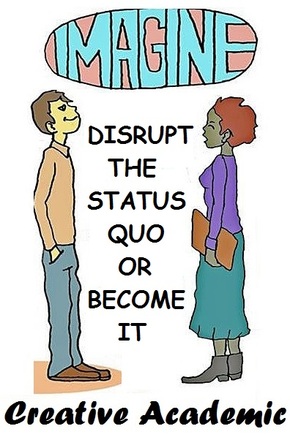
Disrupting the status quo in order to do something that is significantly different to what has been done before is an important objective of creativity. Sadly, most universities don't like disruption, in fact they are positively risk averse: so all too often, even if we have a good idea, we play safe and shy away from possible criticism and carry on doing what we have always done because its easier and we are less likely to get criticised. Trying to be creative in order to innovate involves courage and conviction, energy, effort and time, quite apart from the ideas and vision that drives the process.

Because of these organisational cultural pressures, for many academics, the excitement of learning and the excitement of teaching and helping others learn is not always visible. But does it have to be this way? What are the consequences for us, our learners and our society as a whole if we do not take the risks associated with disrupting ourselves and the current education we provide in order to strive for something better?

I am an academic developer a role which contains within it the seeds of educational disruption - in order to advance understanding and practice! But those seeds have to be planted and helped to grow. I try to fulfil this role by teaching on programmes that lead to teaching qualifications in Higher Education, further CPD programmes, facilitating workshops and open courses but also through supporting individual colleagues and teams. At the heart of my approach is building relationships and trust with colleagues and working in partnership through modelling practices, immersion and co-creation. This, becomes a powerful vehicle for change.  A while back I asked a new colleague what he loves about his job as an academic. The answer came as no surprise to me. He said research. My response was "you will need to learn to love teaching too". And my big question is how can we achieve this. How can we help academics use their love for research and experimentation and learn to love teaching? Is the answer in the question perhaps? If academics use their curiosity to make new discoveries through experimentation and research, what stops them using their curiosity to create stimulating, playful and imaginative learning experiences for them and their students?

Picture
I wanted to find out so I developed a special 'Creativity for Learning' unit for the Postgraduate Certificate and the Masters in Academic Practice within the Centre for Excellence in Learning and Teaching at Manchester Metropolitan University. Its purpose is to introduce academics to the concept of creativity through immersion into playful approaches to learning and development. While some might not recognise the value of creating such a unit and would argue that creativity needs to underpin all our activities and a programme more holistically, I went ahead with the creation of this unit to explore if this unit could act as a 'greenhouse' for growing creative action within an academic community by providing a safe and collegial space and unzip academics' minds and provide food for thought around how they could make changes in their practices to awaken their own and students creative curiosity and discover fresh excitement.  By giving participants the permission, freedom and encouragement to experiment I will be interested to see what emerges and if they change their understandings and conceptions of what creativity means to them in the context of their own learning and teaching when they disrupt their own practice.

An Open Learning Ecology
In addition to running the course internally within MMU we are also offering an open version linked to this through the Peer to Peer University (p2pu) in collaboration with Lifewide Education. We decided to do this as it will encourage others to join in and therefore extend and enrich our conversations and debates around creativity in Higher Education even further. The Creativity for Learning in Higher Education open learning ecology within p2pu is currently under construction and there will be multiple exciting ways to get involved, share experiences and make new discoveries.  Have a look at https://p2pu.org/en/courses/2615/creativity-for-learning-in-higher-education/ to get a taste of what is going to start unfolding from the end of January 2015.

Collaborative inquiry 
As my questions around conceptions of creativity in the context of learning and teaching are important and fundamental for current and future practices, I teamed up with Prof. Norman Jackson who has spent many years trying to understand what creativity means in higher education and encouraging universities to do more to nurture students' creative development. Much of this work is now available as an open resource on his new Creative Academic website  http://www.creativeacademic.uk Norman has influenced my thinking and practice and provided a window into the world of creative and playful teaching that underpins my teaching philosophy and practice. This project will help us gain a deeper insight into the conceptions of creativity as expressed and lived by academics and also provide a useful vehicle for my own further professional development through collaborative research.

The Creative Academic project aims to explore conceptions of personal creativity in the context of learning and teaching in higher education. The project will investigate:

1) The beliefs, attitudes and values of higher education teachers in respect of their own creativity and its importance to their personal and professional identity

 2) The beliefs, attitudes and values of higher education teachers in respect of their understandings of what creativity means in the context of their teaching, their curricular designs and students' development.

3) The ways in which higher education teachers encourage students to use and develop their creativity.

4) The extent to which understandings and meanings of creativity are enhanced or changed as participants try to implement their creative ideas.

While part of the project will be conducted with colleagues in my own institution and help us gain an insight into our evolving conceptions of creativity as we engage in the Creativity for Learning unit, the collaborative inquiry is also open to any higher education teacher who wants to participate. You can join us by registering your interest and completing the on-line questionnaire at http://www.creativeacademic.uk/questionnaires.html

Source
1) Christensen C. M. and Eyring H. J. (2011) The Innovative University: Changing the DNA of Higher Education from the Inside Out

Chrissie Nerrantzi
Manchester Metropolitan University

6 Comments

The Tangible and the Infinite: The Lifewide Learning Potential and benefit of a Career Sabbatical

11/15/2014

24 Comments

 
Picture
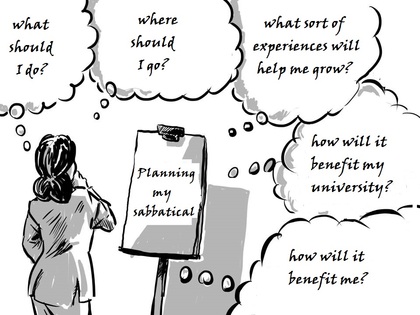
A period of sabbatical is a luxury afforded to academic staff working in universities in some parts of the world. I am fortunate to work at a research-intensive, high performing university in New Zealand which grants sabbatical, or more precisely, Research and Study  Leave, to academic staff fulfilling the application criteria.  The Research and Study Leave period is generally six months but in exceptional circumstances, an applicant may be granted a shorter or longer time period. My application fell into the latter category and I was granted two consecutive six month periods of Research and Study Leave. I feel enormously privileged.

A sabbatical or Research and Study Leave period is a time for renewal and rejuvenation.  Used well, it is an opportunity for mental and physical renewal and exploration of creative pursuits.

In applying for Research and Study Leave, the university requires quite detailed information on the goals of the applicant, expected tangible outcomes, benefits to the awarding university, personal and professional development.  The Leave is a luxury but certainly not a holiday!

In my case my overarching goal at the outset of my leave was to carry out research on leadership in higher education with the longer term aim of publishing a single authored book on this topic. This was a new research focus for me. Leadership in higher education is an under-researched topic. As universities are constantly being challenged to change and almost re-invent themselves to align with shifting conceptions of the purpose of higher education, it is time to explore leadership in higher education, to take our role as role models seriously and to understand how to build leadership capability and capacity, as a critical aspect of our social responsibility.

Suffice to say that I have lived up to my expectations of tangible outcomes in the form of publications, manuscripts submitted, work in progress. I have been prolific in peer reviewing for several journals.  I have been offered and accepted invitations to co-publish and co-edit chapters and books on the topic of Leadership in Higher Education. I was fortunate enough to be given permission by my Dean to attend a Leadership Development Programme offered by the Centre for Creative Leadership. I have pushed myself way beyond my comfort zone in giving keynotes and presentations at conferences that are new to me. I was voted on to the position of Vice President of HETL, the International Higher Education Teaching and Learning  Association (www.hetl.org), I have given seminars at several universities in the UK. I have networked extensively through email, social media, Skype and met with senior managers of universities.

I feel a sense of pride in my achievements. I have pushed myself forward professionally and personally and I have extended not just my individual professional impact but also as an ambassador, the reputation of my university.

I can lay out the tangible outcomes of my Research and Study Leave easily. What it is not possible to quantify are the intangible benefits of time out from routine, high pressure, constant small but time consuming demands on a daily basis.

My sabbatical has been one of the richest and most productive periods of my university career but a sabbatical is also a significant challenge.

My partner and I, born and bred Scottish decided to locate back to the homeland for the duration of my R&S Leave. Despite having been back and forth many times in the decade we have lived in NZ, it was a shock to see, feel and live the impact of the austerity measures brought in by the UK government in the wake of the Global Economic Crisis. We had to fit ourselves back into the new milieu of our old neighbourhood;  live the challenge of an overcrowded area with tensions between the dominant population and new immigrants from Eastern European countries. It was thrilling to be in Scotland at the time of the Commonwealth Games, an event which without doubt captured the nation, and for which Glasgow, the host city, put on its Sunday best for the duration of the event and showed the very best it has to offer in hospitality, good humour and excellent sportsmanship.

Astonishing too to be in a small country seeking its independence from the rest of the UK;  to see the wholehearted re-engagement in politics and the political process across all ages from sixteen upwards, with an 85% turnout for the referendum vote. No matter that the YES campaign lost, the referendum itself changed politics not just in Scotland but across the whole of the UK.

Being interested in leadership in general, who are our role models, what characteristics do good leaders display, it has been a fascinating experience to watch leadership in action in all different contexts. Re-familiarising ourselves with the current state of political play in Scotland and across the UK, comparing how the UK is faring in comparison to cities in Europe has felt like a lifetime’s learning.  However well one keeps up with the news not only at local level but also international events, it is a shock to the system to come back to the Northern Hemisphere and be so exposed to the horrors of world events which are reported on much more extensively here than in New Zealand.  Such an experience of coming ‘home’ has re-enforced my understandings of cultural differences and nuances, and the shifting cultural psyche.


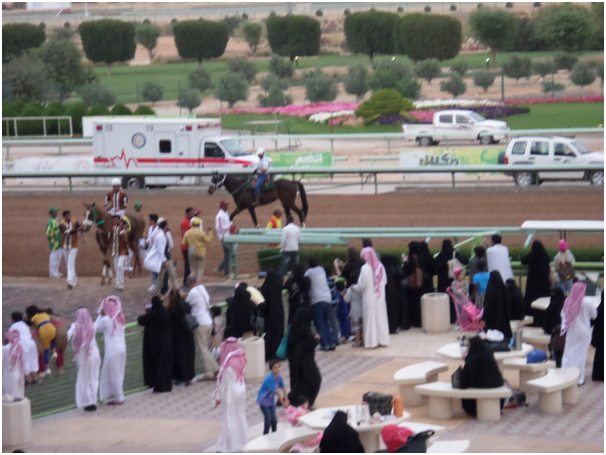
While one is liberated from routine while on sabbatical, the potential of and for learning is incalculable – it is lifewide, it is looking outside of the relatively safe haven of academia and our professional or discipline based knowledge and learning. It is akin to seeing life in the raw! A sabbatical period is time to see the world through different eyes.Just occasionally in life, an opportunity comes along that could not have been predicted but which will have lasting insights, impact, challenges and learnings and I was lucky enough to be offered such an opportunity.  I had not long commenced my research and Study Leave when I was asked if I would consider locating to Saudi Arabia for a period of time to work at Princess Nora University (PNU) in Riyadh.

Picture
I had been to Saudi Arabia many times before but not to live life there, working, socializing and learning.  It was an extraordinary opportunity albeit I appreciate not all women would necessarily think of this as an outstanding opportunity.  My Dean and I agreed I could take on this consultancy role and that time spent at PNU would be added on to my research and Study Leave.

Living and working in Saudi Arabia gave me incredible insights into the status and the challenges for universities in Saudi Arabia. I learned so much more about Islam and the Islamic culture. I also learned that much of what we take to be and assume to be repression of women, is seen very differently by highly educated Saudi Arabian women, but I also did learn much about the dis-satisfaction of women regarding the right to vote, the right to drive and freedom of movement.

I learned a great deal about intercultural competence, what it really means – and I question whether or not we do a good enough job of supporting students and indeed staff in developing this complex skill or attribute.

By reading the English versions of newspapers in Saudi Arabia, I learned more about relations between countries and cultures in the Middle East. I could feel strongly the rigid hierarchy of power relations. I could begin to understand why it is so difficult for smooth political relations between the West and the Middle East.

I also saw up close and personal, the impacts of the financial squeeze on universities and how the Middle East is a magnet for the Education Business, not necessarily always in the best interests of Saudi institutions, often simply financial transactions. I made many friends in Saudi Arabia and feel greatly privileged to have been asked to support Princess Nora University, Saudi Arabia’s first and the world’s largest women only university, in its endeavour  to set up a Centre for Excellence in Learning and Teaching, and to support the University in strategies for building leadership capability and capacity.

I am now coming to the end of my sabbatical period and brace myself for re-entry into my university. Much will have changed, my roles and responsibilities are different, there will have been procedural changes, staff changes, budget cuts. But, I am also returning with a plan of action, much to offer my Dean and my Faculty.

Personally and professionally I am not in any doubt that I have grown. I hope that my learning, my publications, my tangible impact will be of value not only to the university, but also much more widely than that.  In the less tangible and measurable aspects of sabbatical leave, I hope I will add value to the university, bring my enhanced sense of mindfulness and being mindful, and my global knowledge and understanding to bear on my work on leadership in higher education.

I have crossed boundaries again in my career having been a biochemist who changed career to academic developer and am now transitioning into leadership in higher education and what that means at institutional level.  It is my challenge to blend together the discourses of leadership and higher education and contribute to a new narrative for a new era of higher education.

Personally, my batteries are re-charged. Family and friends have been visited. I have different perspectives on the world, more insight into the actual scale of the current challenges and what it will take to effect significant global change. I am enthused about returning to university life notwithstanding the challenges that might present.

I am grateful to the University of Auckland for the support provided for my Research and Study Leave. I wholeheartedly recommend sabbatical time and fully believe that the added value for the institution is significant with measurable and immeasurable components. From my viewpoint the lifelong and lifewide learning is a treat, a challenge and a privilege. The personal and professional development inherent in study leave is worth its weight in gold.

Professor Lorraine Stefani

Higher Education Strategic Engagement
Faculty of Education
University of Auckland, NZ
24 Comments

NEW PERSPECTIVES ON SOCIAL LEARNING

11/6/2014

10 Comments

 
Picture
This week I came across two blogs that provided me with new perspectives on social learning. The first was Julian Stodd's post on scaffolded social learning (1) in which he sets out to

balance the structure and defined outcomes of formal instructionally oriented learning with the collaborative, co-creative and 'sense making' functions of social contexts for learning in the manner depicted below.

Scaffolded social learning is built around two types of components: formal elements of learning shown as 'boxes' in which the learning is pre-planned and 'bubbles' of social activity in which learning is informal and emergent. At the boundary between each, there is a gateway.

The boxes embody experiences that are formally defined learning: maybe eLearning, classroom or open educational resources. The narrative in these spaces is defined by the designers and teachers who own the space. The bubbles are co-creative, community spaces, places where we can feed out questions, case studies, activities and exercises that are carried out over time and within communities or more participatory collectives(2). Here the narrative is created by the learner and co-created by the other active participants in the social space.

In scaffolded social learning the overall arrangement is defined by an overarching narrative developed and maintained by one or more social leaders who act as brokers and guides. They identify the need or interest and create the purpose, visualise and maintain the structure and facilitate the process through which learning emerges. They are the creators of the ecology for collaborative learning - another important concept in social learning (3).

I connected Julian's concept of scaffolded social learning to Jane Hart's idea of 'learning flows' (3). Jane argues that 'in the age of Facebook and Twitter, and Enterprise Social Networks (ESNs) like Yammer and Jive (where at the heart lies an activity stream that is used for a continuous stream of knowledge exchange) – there is a place for a new learning framework; one that lies between the instructionally designed course and the unstructured knowledge sharing of teams, groups and communities. We call this a Learning Flow.'

A Learning Flow is a continuous steady stream of social micro-learning activities – accessible from the web and mobile devices. Its properties are:

·         continuous – ongoing (ie no end date)
·         steady – eg daily or weekly
·         micro-learning – short – ie taking no longer than 15-20 minutes to undertake
·         involve activity – like reading, watching or listening to something and doing something
·         social – that invite and encourage active participation and contribution
·         streams  –  that are organised and structured in the Flow in weekly themes
·         accessible from web and mobile devices – to ensure that  learning can take place anywhere and at
          anytime

For  individuals, being present in a Learning Flow means having some help to navigate the turbulent waters of a fast flowing constant stream of (new) information and knowledge, retaining control over how and when they get involved, and how they fit it into their daily workload – autonomy is a key element of participation. 

Learning Flows are suitable for:
  • Enterprise use – to provide ongoing updating of teams or groups
  • Educational use – to provide an extra dimension to academic subjects – probably alongside a 

          formal curriculum
  • Professional use  - for generic topics of interest in areas like Marketing, Leadership, L&D, etc, where it is vital to keep up with new knowledge and practices.
  • Personal development use - topics of interest that are not directly related to work but are relevant to leading a more fulfilled and meaningful life and indirectly might enhance professional performance can be

Jane describes three types of Learning Flow to encourage short social learning experiences.

(1) NEWS FLOW provides a daily social-micro learning activity based on current news and resources from the Social Web. This is a useful way of encouraging a group of people to reflect on and discuss up-to-the-minute news. This type of Learning Flow is closest to the unstructured learning that takes place in activity streams, but it has the advantage that the participants are only subjected to one piece of news daily  - so that the “signal has been separated from the noise” by the Learning Flow Guide.

(2) THEMED FLOW provides daily social micro-learning activities organized within weekly themes around a specific topic. This is a useful way for bringing together related activities in some logical sequence during the week, so that the Learning Guide can help the participants to “join the dots”  between new ideas and resources.  

(3) CIRCULAR FLOW is a rotating flow of a set of weekly themes (although activities within them may change). This Learning Flow is closest to the traditional course since it deals with a well defined body of knowledge, but it differs from a course in that content is used to support the social learning experience – rather than social interaction being added to content (as happens in many courses) there is a Guide rather than an Instructor, and there is more autonomy and choice for the user

It seems right that these ideas of scaffolded social learning and learning flows should be connected and integrated. What do you think?

Sources of ideas
1) Julian Stodd Scaffolded Social Learning posted 5 November 2014 http://julianstodd.wordpress.com/2014/11/05/scaffolded-social-learning/
2) Douglas Thomas and John Seeley Brown A New Culture of Learning: Cultivating the imagination for a world of constant change
3) Norman Jackson 'The Concept of Learning Ecologies' in N. J. Jackson and G.B. Cooper (eds) Lifewide Learning, Education and Personal Development e-book  Chapter A5 available on-line at http://www.lifewideebook.co.uk/conceptual.html
4) Jane Hart 'Beyond the Course: The Learning Flow – a new framework for the social learning era' posted 19 February 2014,  http://www.c4lpt.co.uk/blog/2014/02/19/the-learning-flow/
5) Jane Hart 'Three Types of Learning Flow' posted 25 February 2014
http://www.c4lpt.co.uk/blog/2014/02/25/types-of-learning-flow/


10 Comments
<<Previous
Forward>>

    AuthorS

    This blog is maintained by members of the Lifewide Education Community
    Contributors

    Tweet

    Archives

    July 2021
    January 2021
    October 2020
    August 2020
    January 2020
    November 2019
    August 2019
    December 2018
    June 2018
    September 2017
    April 2017
    January 2017
    June 2016
    May 2016
    April 2016
    March 2016
    December 2015
    November 2015
    October 2015
    June 2015
    May 2015
    March 2015
    December 2014
    November 2014
    October 2014
    September 2014

    Categories

    All
    Collectives
    Discouragement
    Disruption
    Encouragement
    Imposter Syndrome
    Influencing Others
    Information Flow
    Leadership
    Learning Ecology
    Learning Flow
    Learning Zone
    Lifewide Magazine
    Making Something New Happen
    Open Education
    Panic
    Personal Learning Networks
    Resilience
    Social Age
    Social Learning
    Social Media

    RSS Feed

Picture
We advocate, encourage and support lifelong - lifewide and ecological approaches to learning, development, creativity and education for a sustainable regenerative future